
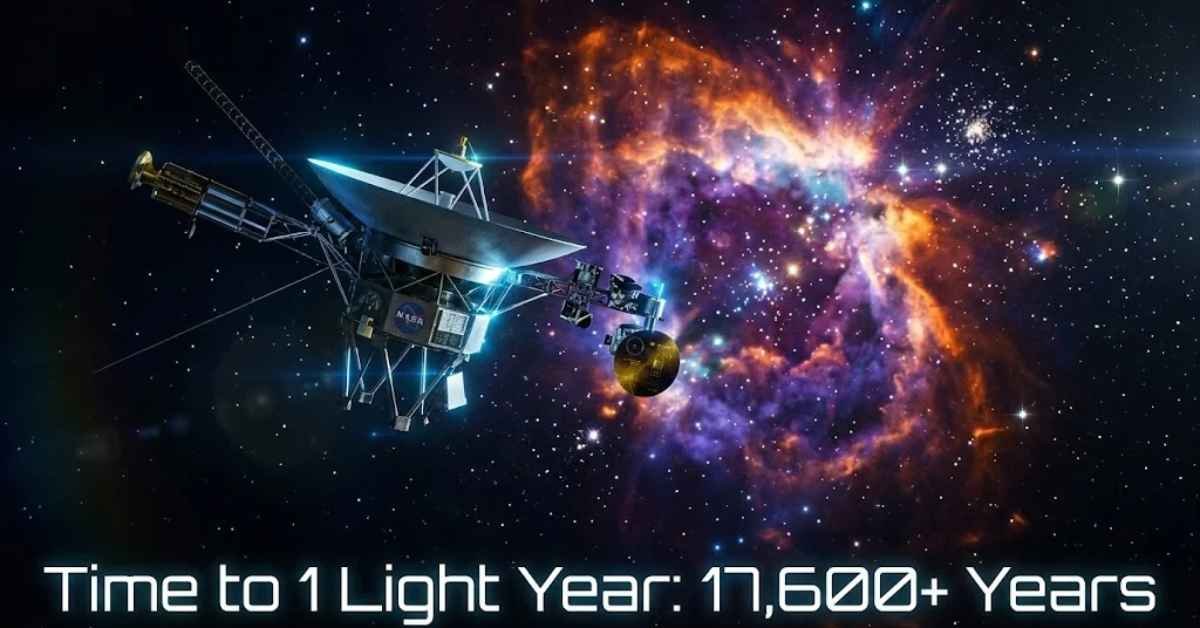
How long to travel one light year
Science fiction movies make traveling through space look incredibly easy. A captain pushes a button, the stars blur into lines, and suddenly the ship has traveled halfway across the galaxy. But in reality, space is terrifyingly huge.
If you want to know how long it would take to travel one light year, you first have to realize that a light year is not a measure of time. It is a measure of extreme distance. To cross it, a human being would need a lot more than a lifetime.
Let’s break down exactly how long it would take to travel just one single light year using different modes of transportation—from walking, to driving, to flying NASA’s fastest rockets.
The Math: Just How Far is One Light Year?
Before we start our engines, we need to know the distance of our road trip. If you want to know exactly what a light year measures, it is the distance light travels in one Earth year.
- Light travels at roughly 186,282 miles per second.
- When you multiply that by a full year, you get roughly 5.88 trillion miles (9.46 trillion kilometers).
To put that in perspective, the Sun is only 93 million miles away. One light year is over 63,000 times further than the Sun. So, how long would it take us to cross that void?
What If You Walked, Drove, or Flew?
Let’s start with everyday human transportation to truly grasp the mind-bending scale of the universe.
Walking (3 mph)
If you put on your walking shoes and maintained a brisk, non-stop pace of 3 miles per hour, without ever stopping to sleep or eat, it would take you approximately 223 million years to walk one light year. The dinosaurs went extinct only 66 million years ago.
Driving a Car (70 mph)
Imagine jumping into a car, hopping on a cosmic highway, and setting the cruise control to 70 miles per hour. Even at highway speeds, it would take you about 9.5 million years to drive a single light year.
Flying a Commercial Jet (550 mph)
What if you boarded a Boeing 747 and flew at a cruising speed of 550 mph? Even zooming through the sky, the journey across one light year would take 1.2 million years.
How Long Using Our Fastest Spacecraft?
Okay, so commercial jets won’t cut it. What if we use the greatest technology human engineers have ever built?
Voyager 1 (38,000 mph)
NASA’s Voyager 1 is currently the farthest human-made object in existence. It is hurtling through interstellar space at roughly 38,000 miles per hour. If Voyager 1 was headed toward a star exactly one light year away, it would take about 17,600 years to get there.
Parker Solar Probe (430,000 mph)
The Parker Solar Probe is the fastest object humans have ever created. At its peak speed (using the Sun’s gravity as a slingshot), it reaches an astonishing 430,000 miles per hour. Even at this record-breaking, blistering speed, it would still take about 1,560 years to travel just one light year.
Will Humans Ever Travel a Light Year?
With our current chemical rockets, it is impossible for a human to survive a journey of one light year, let alone travel to the closest star system (Proxima Centauri, which is 4.24 light years away).
To make interstellar travel a reality, scientists are researching theoretical concepts like:
- Nuclear Propulsion: Using nuclear reactions to sustain much higher speeds over longer periods.
- Solar Sails: Using lasers to push ultra-thin sails through space at a fraction of the speed of light.
- Warp Drives: A purely theoretical sci-fi concept that involves bending space-time around a ship.
Until these incredible technologies become a reality, the stars will remain safely out of our physical reach.
Frequently Asked Questions (FAQs)
Can a human survive traveling a light year?
With current technology, no. The fastest spacecraft would take over 1,500 years to travel one light year. A human crew would not survive the journey without generational ships or hypothetical cryogenic freezing.
How long does it take light to travel one light year?
By definition, it takes light exactly one Earth year to travel a distance of one light year.
How far is the closest star in travel time?
The closest star to Earth (besides the Sun) is Proxima Centauri, located 4.24 light years away. Using Voyager 1’s speed of 38,000 mph, it would take roughly 75,000 years to reach it.