
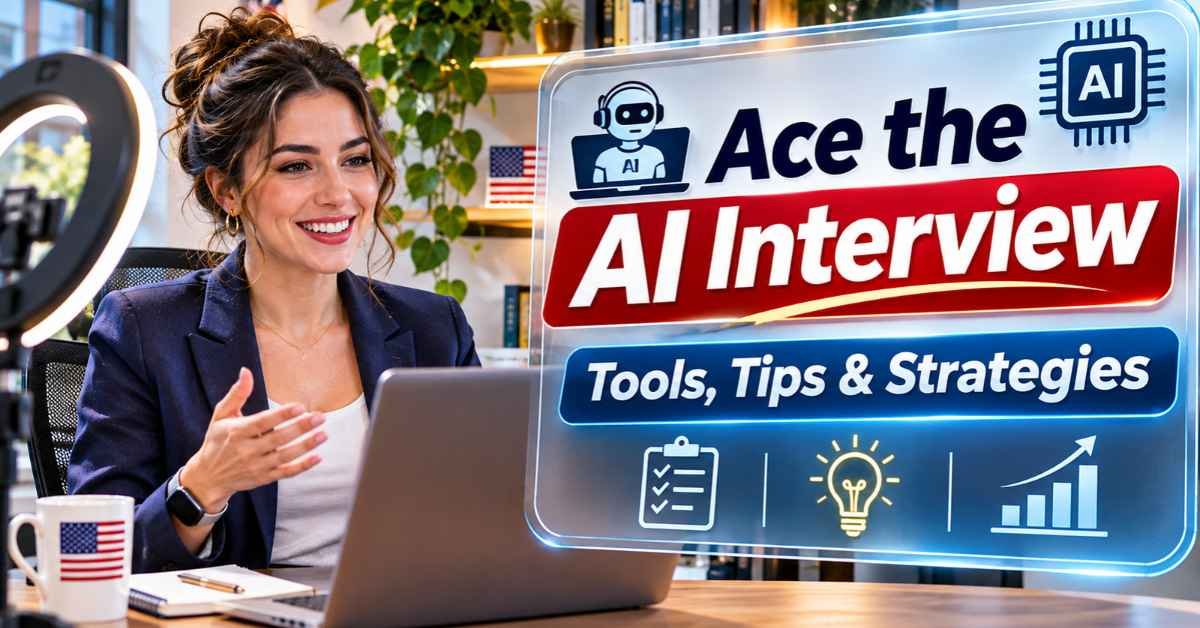
AI Job Interview
In the highly competitive United States job market, the traditional hiring process has undergone a massive digital transformation. If you are applying for a role at a Fortune 500 company, a tech startup, or even a large retail chain, there is a high probability that your first round of screening will not be with a human recruiter. Instead, you will face an AI Job Interview.
Powered by Natural Language Processing (NLP) and machine learning algorithms, asynchronous AI interviews (like HireVue) analyze your responses, vocal tone, and keywords to determine if you move on to the next round. Navigating this can feel intimidating, but with the right preparation and practice tools, it is entirely manageable. In this comprehensive guide, we will break down how AI evaluates you, the best tools for practice, and proven strategies to ace your digital screening.
What is an AI Job Interview?
An AI job interview is a one-way, asynchronous video interview. Candidates log into a platform, read or listen to pre-recorded prompts, and record their answers via webcam. There is no human on the other side of the screen. Once submitted, artificial intelligence software evaluates the video to score the candidate against the core competencies required for the role.
| Interview Format | Asynchronous (One-way video recording) |
| Primary Evaluator | Natural Language Processing (NLP) Algorithms |
| Average Duration | 15 to 30 Minutes |
| Common Platforms | HireVue, Modern Hire, Spark Hire |
| Key Evaluation Metrics | Keywords, Speech clarity, Answer structure |
How Does the AI Evaluate Candidates?
To beat the algorithm, you must first understand how it works. Modern AI screening tools have largely moved away from analyzing facial micro-expressions (due to bias concerns) and now focus heavily on verbal content and delivery.
- Keyword Matching: The AI transcribes your audio into text and cross-references it with the job description. Using industry-specific terminology is critical.
- Answer Structure: Algorithms favor logical, well-structured responses. Candidates who use the STAR method (Situation, Task, Action, Result) naturally score higher because their answers are cohesive and easy to parse.
- Vocal Delivery & Pace: The software analyzes your speaking rate, pauses, and clarity. Speaking too fast out of nervousness or using excessive filler words (“um,” “like”) can negatively impact your score.
Top AI Tools for Interview Practice
You wouldn’t take a major exam without taking a practice test first. Thankfully, there are dedicated platforms designed to simulate the AI interview experience and provide instant feedback.
1. Interviewsby.ai
This tool is excellent for generating tailored, role-specific questions. By leveraging ChatGPT-style models, Interviewsby.ai allows you to input the exact job title you are applying for. It then conducts a mock interview, records your answers, and provides highly specific feedback on your content, helping you refine your talking points before the real thing.
2. Huru.ai
Huru.ai acts as a personal interview coach right on your smartphone or desktop. It boasts a database of over 20,000 mock interviews across various professions. What makes Huru stand out is its deep analysis of your vocal pacing, facial expressions (for general engagement), and filler word usage. It provides a comprehensive scorecard immediately after your practice session.
5 Proven Strategies to Ace an AI Interview
Preparing for an AI screening requires a blend of technical setup and behavioral readiness. Follow these five steps to ensure you stand out:
- Optimize Your Setup: Ensure you have a neutral background, bright front-facing lighting (like a ring light), and a high-quality external microphone. If the AI cannot clearly transcribe your voice, you will lose points.
- Look at the Lens, Not the Screen: Eye contact in a digital interview means staring directly into the camera lens. This mimics natural eye contact and signals confidence to human recruiters who may review the tape later.
- Master the STAR Method: When asked behavioral questions, structure your answer strictly:
- Situation (Set the scene)
- Task (What was your responsibility?)
- Action (What specific steps did you take?)
- Result (What was the measurable outcome?)
- Echo the Job Description: Print out the job description and highlight key verbs and hard skills. Naturally weave these exact words into your responses.
- Utilize the Practice Runs: Almost all AI platforms offer a “practice question” before the recorded session begins. Use this to check your audio levels, lighting, and framing.
Frequently Asked Questions (FAQs)
Q1. Do human recruiters actually watch AI interviews?
Ans: Yes, but usually only if you pass the initial AI screening. The AI filters out the bottom tier of candidates, and human hiring managers review the top-scoring videos to make the final selection for in-person interviews.
Q2. Can AI detect if I am reading from a script?
Ans: While the AI might not “know” you are reading, reading from a script often results in a monotonous vocal tone, lack of natural pauses, and lack of eye contact with the camera. This will negatively impact your overall delivery score. It is better to use bullet points on sticky notes near the camera.
Q3. What happens if I get disconnected during an AI interview?
Ans: Most enterprise platforms (like HireVue) automatically save your progress. If your internet drops, you can usually log back in using the same link and resume from where you left off. However, it is highly recommended to use a stable, hardwired connection if possible.
Q4. How should I dress for a one-way video interview?
Ans: You should dress exactly as you would for an in-person interview. Even though an AI is analyzing your words, human recruiters will eventually watch the footage. Professional attire conveys respect for the opportunity and the company culture.
Navigating the modern job market requires modern strategies. By leveraging practice tools and understanding how the algorithm evaluates your responses, you can turn the AI screening from an obstacle into your biggest advantage. Bookmark this guide to prep for your next big interview!