
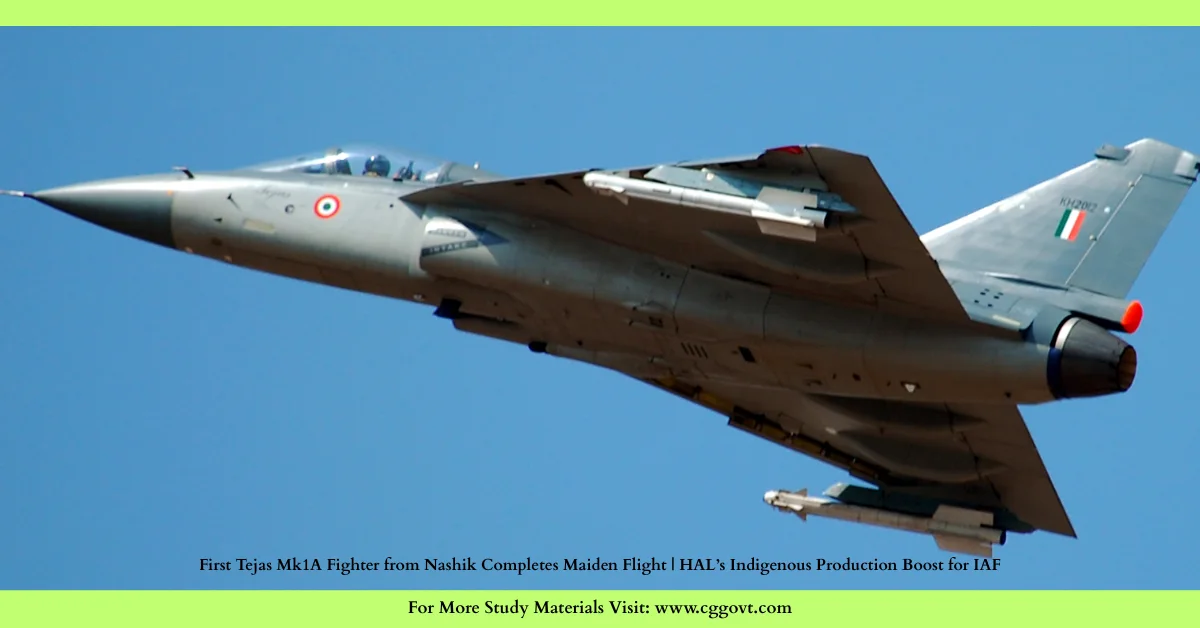
First Tejas Mk1A Fighter
India’s quest for self-reliance in defence manufacturing took a major leap forward on 17 October 2025, when the first Tejas Mk1A fighter jet produced at Hindustan Aeronautics Limited (HAL)’s Nashik complex successfully completed its maiden flight. The event was celebrated with a water cannon salute, symbolizing India’s growing confidence in indigenous aerospace capability. Defence Minister Rajnath Singh had recently inaugurated both the Tejas Mk1A and HTT-40 trainer aircraft assembly lines at Nashik, cementing HAL’s position as a multi-site producer of advanced combat aircraft.
A Leap in Indigenous Production Capacity
The Nashik Advantage
Nashik now serves as HAL’s third Light Combat Aircraft (LCA) production line, joining two existing lines in Bengaluru. The new facility, established with an investment exceeding ₹150 crore, can manufacture up to eight Mk1A aircraft annually. Together, the three lines aim to produce around 24 aircraft per year, eventually scaling to 30 fighters annually by 2026–27 through private sector partnerships.
Private Sector Participation
HAL has partnered with Indian firms such as VEM Technologies (centre fuselage), Alpha (rear fuselage), and Larsen & Toubro (L&T) (wings). This supply chain is designed to add six more aircraft annually. The collaboration reflects India’s emerging public-private defence ecosystem, where domestic firms play key roles in national security production.
Technical Highlights and Integration Challenges
Weapons and Radar Trials
Before formal induction into the Indian Air Force (IAF), the Tejas Mk1A must clear weapon and radar integration tests, including trials with Astra beyond-visual-range missiles, short-range air-to-air missiles, and laser-guided bombs. A major upgrade is the integration of the Israeli-origin ELTA ELM-2052 radar, alongside India’s Uttam AESA radar, which is undergoing advanced qualification.
Engine Supply Constraints
Production has faced delays due to slow delivery of GE F404 engines. Only four of the 99 engines ordered in 2021 under a ₹5,375 crore contract have arrived so far. GE has promised eight more engines by March 2026 and 20 annually thereafter. HAL has managed to continue flight testing by rotating available engines among aircraft, a strategy that demonstrates its adaptive management.
Strategic Context and Future Outlook
Meeting IAF’s Urgent Needs
Air Chief Marshal A. P. Singh has emphasized that the IAF is currently short of fighters and requires at least 40 new aircraft each year to maintain operational strength. The first batch of 83 Mk1A aircraft cleared in 2021 and an additional 97 jets approved in August 2025 worth ₹66,500 crore together represent a 180-aircraft order, reaffirming confidence in India’s aerospace capabilities.
Towards Next-Generation Fighters
The Mk1A is only one step in India’s broader aerospace journey. HAL and DRDO are advancing projects like the Tejas Mk2 Medium Weight Fighter and the Advanced Medium Combat Aircraft (AMCA). These initiatives aim to position India among the few nations capable of designing and manufacturing both 4.5+ and 5th-generation combat aircraft indigenously.
Conclusion
The maiden flight of the first Nashik-built Tejas Mk1A marks a defining moment in India’s journey toward technological sovereignty. Despite challenges such as engine supply delays and radar integration issues, HAL’s expanding production network and collaboration with private industry highlight a strong foundation for self-reliance. For UPSC and State PSC aspirants, this case provides an exemplary study of India’s defence industrial strategy, Make in India initiative, and the critical intersection of technology, policy, and national security.