
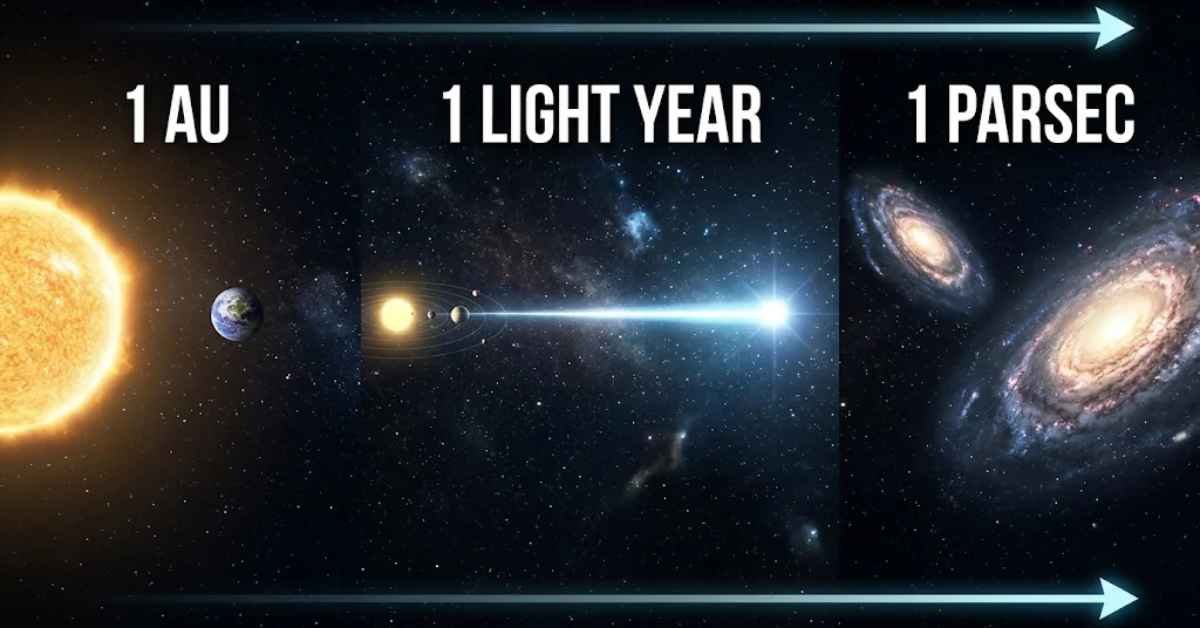
Difference between light year and parsec
If you have ever read an article about space, you have probably seen astronomers throw around terms like Light Years, Parsecs, and Astronomical Units (AU). But why are there so many different ways to measure space, and which one is the biggest?
The short answer is that space is simply too massive for standard miles or kilometers. If astronomers used miles to measure the distance to other galaxies, the numbers would have so many zeroes that they would be impossible to read. To solve this, they created a “cosmic ruler” with different units for different scales.
Here is the ultimate guide to understanding the difference between a Light Year, a Parsec, and an Astronomical Unit.
Quick Comparison of Space Measurement Units
If you just need a quick cheat sheet for your homework or general curiosity, here is how the “Big Three” space units compare:
| Measurement Unit | Distance in Miles (Approx.) | Best Used For… |
|---|---|---|
| Astronomical Unit (AU) | 93 million miles | Measuring distances within our Solar System. |
| Light Year (ly) | 5.88 trillion miles | Measuring distances to nearby stars and across our galaxy. |
| Parsec (pc) | 19 trillion miles | Measuring massive distances between different galaxies. |
What is an Astronomical Unit (AU)?
An Astronomical Unit (AU) is the smallest of the three major space measurements. It is based directly on our own neighborhood: 1 AU is the average distance from the center of the Earth to the center of the Sun.
- Distance: About 93 million miles (150 million kilometers).
- When do astronomers use AU? AU is the perfect “yardstick” for measuring distances right here in our own Solar System.
For example, instead of saying Jupiter is roughly 484 million miles from the Sun, astronomers just say it is about 5.2 AU away. Pluto sits at about 39 AU from the Sun. It makes the math much cleaner and easier to understand.
What is a Light Year?
As you move outside of our solar system, the AU becomes too small to be useful. That is where the Light Year comes in. Despite the word “year,” what a light year actually measures is distance, not time.
- Distance: About 5.88 trillion miles (9.46 trillion kilometers).
- How is it calculated? It is the total distance that a beam of light can travel through the vacuum of space in one Earth year.
- When do astronomers use Light Years? This unit is used for measuring the distances to other stars and mapping out the size of our Milky Way galaxy.
For context, the closest star system to Earth (besides our Sun) is Alpha Centauri, which is about 4.36 light years away.
What is a Parsec?
A Parsec (parallax second) is the gold standard for professional astronomers and astrophysicists. It is the largest standard unit of the three.
- Distance: 1 Parsec is equal to 3.26 Light Years, or about 19 trillion miles (30.9 trillion kilometers).
- When do astronomers use Parsecs? Parsecs are used for mind-boggling, deep-space distances, such as measuring the vast emptiness between different galaxies.
Why use parsecs instead of light years? The parsec is deeply tied to how astronomers physically calculate the distance to stars using geometry and a visual effect called “parallax” (how a star appears to shift position when viewed from opposite sides of Earth’s orbit). Because it is rooted in strict mathematical observation, professional scientists prefer it over the light year.
Summary: Which Unit is the Biggest?
If you are ranking these space measurement units from smallest to largest, the order is:
- Astronomical Unit (AU): The smallest (93 million miles).
- Light Year: The middle weight (63,241 AU / 5.88 trillion miles).
- Parsec: The largest (3.26 Light Years / 19 trillion miles).
(Note: For extreme cosmic distances, astronomers scale up the parsec by using Megaparsecs. One Megaparsec equals one million parsecs!)
Frequently Asked Questions (FAQs)
Is a parsec bigger than a light year?
Yes. A parsec is significantly larger than a light year. One parsec is equal to approximately 3.26 light years, making it the preferred unit for measuring vast intergalactic distances.
How many AU are in a light year?
There are roughly 63,241 Astronomical Units (AU) inside a single light year. This shows just how massive the jump in scale is once you leave our solar system.
Did Han Solo use “Parsec” incorrectly in Star Wars?
Yes! In the original Star Wars movie, Han Solo bragged that his ship, the Millennium Falcon, made the Kessel Run in “less than twelve parsecs.” Since a parsec is a unit of distance, not time, this was technically a scientific error. However, later movies cleverly explained this away by stating that Han found a shorter physical route through a dangerous area of space.