
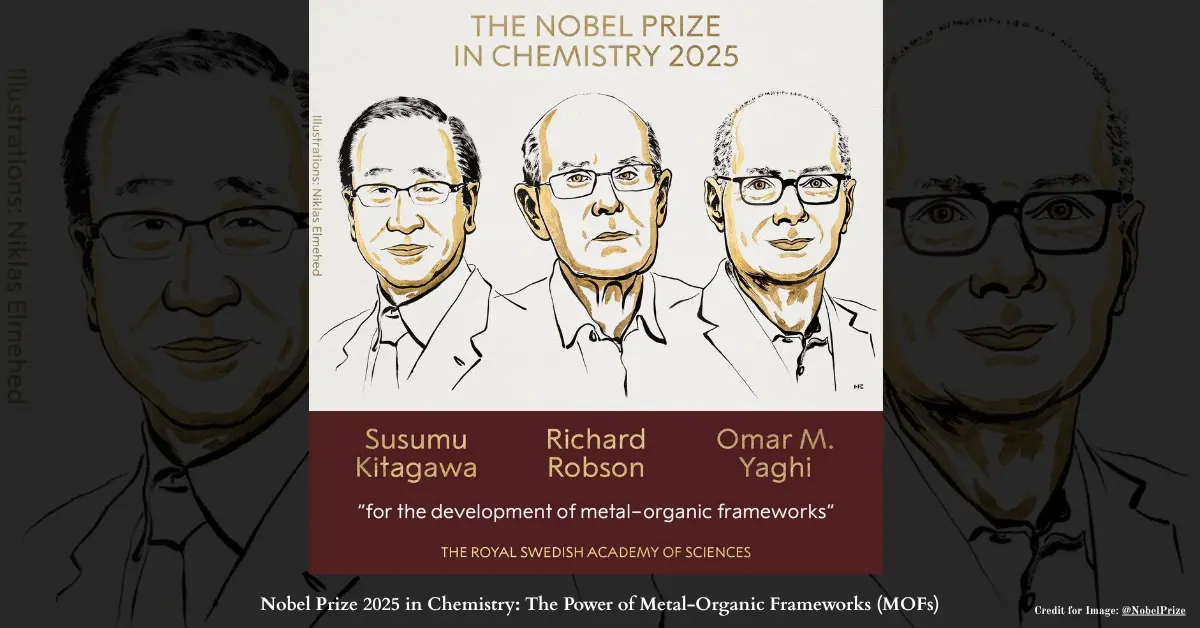
Nobel Prize 2025 in Chemistry
In 2025, the Nobel Prize in Chemistry was awarded to Susumu Kitagawa, Richard Robson, and Omar Yaghi for their groundbreaking discovery of Metal-Organic Frameworks (MOFs) — materials that seamlessly combine the strength of metals with the versatility of organic compounds. This revolutionary invention stands as a bridge between inorganic and organic chemistry, marking a new era in sustainable material science and environmental innovation.
MOFs are crystalline, porous structures capable of absorbing gases and water molecules, purifying toxins, and even harvesting water from the driest deserts. Their development showcases how decades of curiosity-driven research can transform scientific understanding into real-world sustainability solutions.
The Journey of Discovery
The story of MOFs began in the 1970s, when Richard Robson from the University of Melbourne conceptualized connecting metal ions with organic molecules to form three-dimensional frameworks. Although his early models were unstable, they sparked a scientific movement.
In the 1990s, Susumu Kitagawa of Kyoto University refined the design by creating flexible and gas-permeable versions of these frameworks. Finally, Omar Yaghi of the University of California, Berkeley, revolutionized the field by stabilizing the structures, naming them Metal-Organic Frameworks, and demonstrating their immense utility in capturing carbon dioxide and extracting water from desert air.
Scientific Significance
MOFs represent one of the most significant breakthroughs in modern chemistry. Unlike traditional materials, they offer enormous surface areas and can be tailored at the molecular level to perform specific functions. Their porous design enables them to trap gases, filter chemicals, and store energy efficiently.
Researchers have since developed tens of thousands of MOFs, expanding applications from environmental cleanup to drug delivery and renewable energy systems. The 2025 Nobel Committee highlighted that such materials could play a critical role in addressing the planet’s dual crises of water scarcity and pollution.
Challenges and Future Prospects
Early versions of MOFs were unstable and difficult to scale up for industrial use. Over time, through molecular engineering and AI-assisted design, scientists have improved their durability and functionality. Future research aims to make MOFs economically viable and environmentally sustainable for widespread applications — especially in developing nations facing acute water and air crises.
Exam Relevance
- UPSC GS Paper III: Environment, Science & Technology, Sustainable Development
- State PSCs: Nobel Awards, Innovations in Chemistry, Environmental Policies
- Prelims: MOF applications, scientists’ names, and related discoveries
Conclusion
The discovery of Metal-Organic Frameworks signifies not just a scientific triumph but also a message of sustainability. It shows how persistent innovation, global collaboration, and imagination can yield solutions to humanity’s greatest environmental challenges. For UPSC and PSC aspirants, this topic embodies the spirit of applied science — where chemistry meets climate resilience.