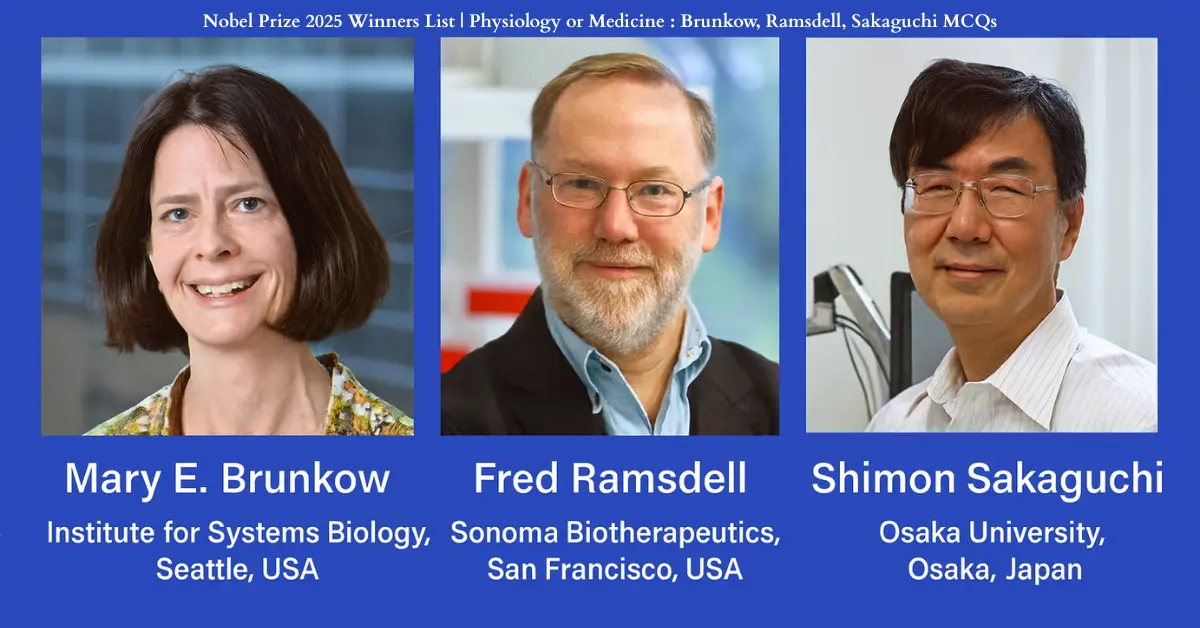
Nobel Prize 2025 – Physiology or Medicine
Announced on 6 October 2025 by the Nobel Assembly at Karolinska Institutet, Solna.
Laureates: Mary E. Brunkow, Fred Ramsdell, Shimon Sakaguchi —
“for their discoveries concerning peripheral immune tolerance.”
About the Prize and 2025 Medicine Laureates
The Nobel Prizes, established by Alfred Nobel’s 1895 will and first awarded in 1901, recognise contributions that confer
the greatest benefit to humankind. Each award typically includes a gold medal, a diploma, and a cash amount (in recent years,
11 million SEK). Prizes may be shared by up to three individuals; the Peace Prize may also be awarded to organisations.
In 2025, Mary E. Brunkow, Fred Ramsdell and Shimon Sakaguchi were honoured for foundational work explaining how the immune
system avoids attacking the body’s own tissues. Their research identified regulatory T cells (Tregs) as key “security guards”
and linked the Foxp3 gene to Treg development and to severe autoimmunity when mutated.
Nobel Prize 2025 – Category Schedule
| Category | Date (2025) | Presented By | Winners | Contribution |
|---|
| Physiology or Medicine | 6 Oct | Nobel Assembly, Karolinska Institutet (Solna) | Mary E. Brunkow, Fred Ramsdell, Shimon Sakaguchi | Discoveries concerning peripheral immune tolerance |
| Physics | 7 Oct | Royal Swedish Academy of Sciences (Stockholm) | To be announced | – |
| Chemistry | 8 Oct | Royal Swedish Academy of Sciences (Stockholm) | To be announced | – |
| Literature | 9 Oct | Swedish Academy (Stockholm) | To be announced | – |
| Peace | 10 Oct | Norwegian Nobel Committee (Oslo) | To be announced | – |
| Economic Sciences | 13 Oct | Royal Swedish Academy of Sciences (Stockholm) | To be announced | – |
Question 1:
The 2025 Nobel Prize in Physiology or Medicine was awarded for discoveries concerning which concept?
A. Central immune tolerance only
B. Peripheral immune tolerance
C. Antibody class switching
D. RNA vaccines
Show Answer and Explanation
Correct Answer: (B)
The citation explicitly states “for their discoveries concerning peripheral immune tolerance.”
Memory Tip: Think “periphery protects” — tolerance maintained outside the thymus.
Question 2:
Who are the 2025 laureates in Physiology or Medicine?
A. James P. Allison and Tasuku Honjo
B. Emmanuelle Charpentier and Jennifer Doudna
C. Mary E. Brunkow, Fred Ramsdell, and Shimon Sakaguchi
D. Albert Fert and Peter Grünberg
Show Answer and Explanation
Correct Answer: (C)
The Nobel Assembly named Mary E. Brunkow, Fred Ramsdell, and Shimon Sakaguchi as joint laureates for 2025.
Memory Tip: Remember “BRS” — Brunkow, Ramsdell, Sakaguchi.
Question 3:
Which gene is identified as governing the development of regulatory T cells (Tregs)?
A. BRCA1
B. Foxp3
C. p53
D. RAG1
Show Answer and Explanation
Correct Answer: (B)
Foxp3 governs Treg development; mutations are linked to severe autoimmunity (IPEX in humans).
Memory Tip: “Fox” guards — Foxp3 guards tolerance via Tregs.
Question 4:
In 2001, Brunkow and Ramsdell reported a mutation in Foxp3 in a mouse strain. What did this explain?
A. Resistance to bacterial infection
B. Vulnerability to autoimmune disease
C. Enhanced antibody production
D. Loss of memory B cells
Show Answer and Explanation
Correct Answer: (B)
They showed the mutation explained the mouse strain’s susceptibility to autoimmune diseases; human Foxp3 mutations cause IPEX.
Memory Tip: “Foxp3 faulty → self-reactivity.”
Question 5:
Assertion (A): Regulatory T cells prevent immune cells from attacking self tissues.
Reason (R): The 2025 Nobel work linked Foxp3 to the development of these cells.
A. Both A and R are true; R correctly explains A
B. Both A and R are true; R does not explain A
C. A true; R false
D. A false; R true
Show Answer and Explanation
Correct Answer: (A)
The passage states Tregs ensure tolerance of self tissues, and Foxp3 governs their development, explaining the mechanism.
Question 6:
Chronology: Arrange the events as per the text.
A. 2001 Foxp3 mutation → 1995 Treg discovery → 2 years later Foxp3-Treg link
B. 1995 Treg discovery → 2001 Foxp3 mutation → 2 years later Foxp3-Treg link
C. 1995 Treg discovery → 2 years later Foxp3-Treg link → 2001 Foxp3 mutation
D. 2001 Foxp3 mutation → 2 years later Foxp3-Treg link → 1995 Treg discovery
Show Answer and Explanation
Correct Answer: (B)
Sakaguchi’s 1995 discovery → Brunkow & Ramsdell’s 2001 Foxp3 mutation → two years later, Sakaguchi linked Foxp3 to Treg development.
Memory Tip: 1995 → 2001 → +2 years.
Question 7:
Which institution announces the Nobel Prize in Physiology or Medicine?
A. Royal Swedish Academy of Sciences
B. Swedish Academy
C. Nobel Assembly at Karolinska Institutet
D. Norwegian Nobel Committee
Show Answer and Explanation
Correct Answer: (C)
The Medicine prize is announced by the Nobel Assembly at Karolinska Institutet, Solna.
Question 8:
According to the passage, research on peripheral tolerance has spurred development of treatments currently:
A. Abandoned due to side effects
B. Approved globally for all cancers
C. Undergoing clinical trials
D. Limited to animal models only
Show Answer and Explanation
Correct Answer: (C)
The text notes several such treatments are now undergoing clinical trials.
Question 9:
Multiple Select: Which statements are directly supported by the text?
A. Up to three people can share a Nobel Prize.
B. The Peace Prize can be awarded to organisations.
C. Laureates receive a gold medal, diploma, and a cash prize.
D. The Medicine prize is announced in Oslo.
Show Answer and Explanation
Correct Answer: (A), (B), (C)
All are stated in the narrative; Oslo pertains to the Peace Prize, not Medicine.
Question 10:
The 2025 award focuses on central tolerance via thymic deletion only.
Show Answer and Explanation
Correct Answer: (B)
It recognises peripheral immune tolerance, not central tolerance alone.
Question 11:
Which scientist first identified a previously unknown class of immune cells protecting against autoimmunity (1995)?
A. Mary E. Brunkow
B. Fred Ramsdell
C. Shimon Sakaguchi
D. Alfred Nobel
Show Answer and Explanation
Correct Answer: (C)
Sakaguchi’s 1995 discovery identified the cell class later recognised as regulatory T cells.