
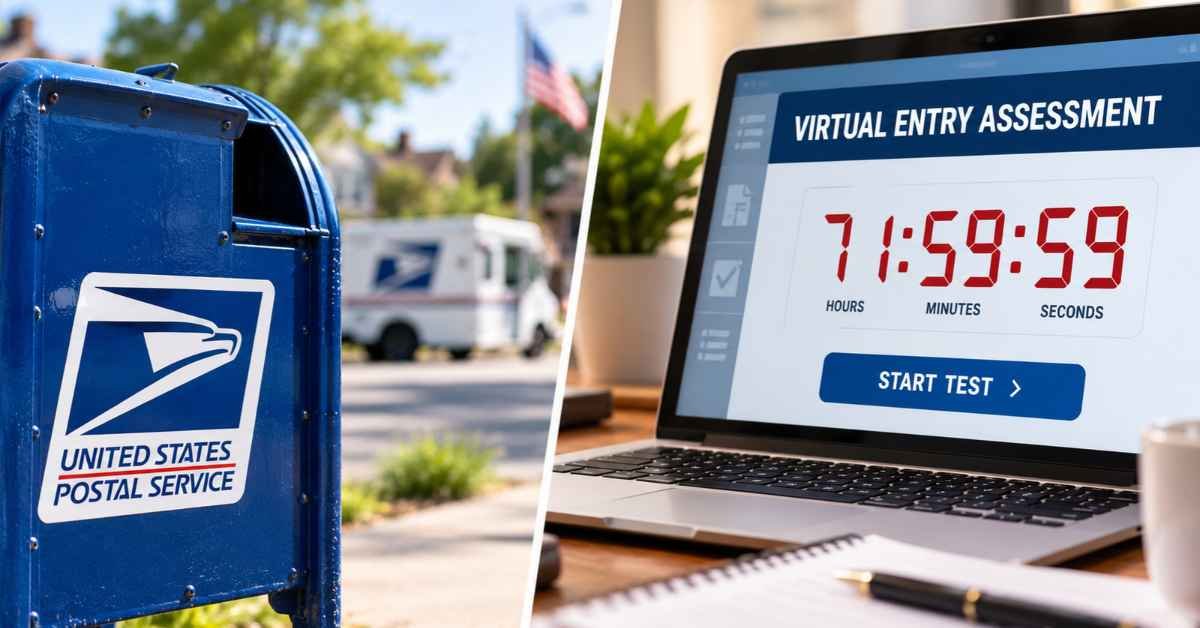
USPS Virtual Entry Assessment
Securing a job with the United States Postal Service (USPS) is highly competitive, thanks to the robust federal benefits, pension security, and union protection it offers. However, the path to getting hired has completely changed. If you are preparing to memorize zip codes and sorting routes, you are studying for a test that no longer exists.
The USPS has entirely overhauled its hiring process, replacing traditional knowledge-based exams with a highly psychological screening tool known as the Virtual Entry Assessment (VEA). Because the stakes are incredibly high—failing means you are locked out of the hiring system for an entire year—understanding how this new assessment works is critical to landing the job.
The Death of Exam 473 (And What Replaced It)
For decades, the Postal Exam 473 was the universal gateway to a career at the post office. It tested rote memorization, address checking, and manual sorting speed. Today, the 473 is officially dead. The USPS realized that checking addresses didn’t predict if an employee would be reliable, customer-friendly, or safe on the job.
Now, depending on the specific job you apply for, you will be assigned one of four new Virtual Entry Assessments:
- Exam 474: For City and Rural Mail Carriers.
- Exam 475: For Mail Handlers (warehouse environments).
- Exam 476: For Mail Processing Clerks.
- Exam 477: For Customer Service Clerks (working the front retail counter).
The 72-Hour Rule and the 1-Year Lockout Penalty
The most stressful part of the USPS hiring process is the timeline. The moment you submit your application through the USPS careers portal, the clock starts ticking. You have exactly 72 hours to complete the unproctored digital assessment.
This test is not something you can casually click through. A passing score is a 70. If you score a 69 or lower, the USPS algorithm automatically disqualifies your application. Worse, you are hit with a strict 1-year (12-month) lockout penalty. You will not be permitted to retake that specific exam or apply for any USPS job requiring that exam variant for an entire year.
What is on the Virtual Entry Assessment?
Instead of testing your math or geography skills, the VEA tests your personality, work ethic, and situational judgment. The exams generally consist of three main psychological modules:
- Work Scenarios (Situational Judgment): You are presented with difficult on-the-job scenarios (like dealing with an angry customer or a delayed mail truck) and must choose the best and worst ways to respond.
- Tell Us Your Story (Biodata): A detailed questionnaire about your past employment history, attendance records, and how you interact with supervisors.
- Describe Your Approach (Personality): You will be forced to choose between two positive-sounding statements or two negative-sounding statements to reveal your true workplace behavioral traits.
3 Golden Rules to Beat the USPS Algorithm
To achieve a high score (85 or above) and secure an interview, you must understand what the USPS algorithm is programmed to reward. Keep these three rules in mind when taking the test:
1. Customer Service is King
Even if you are applying for a warehouse job where you rarely see the public, the USPS prioritizes customer satisfaction above almost all else. In situational questions, always choose the answer that solves the customer’s problem politely and efficiently, even if it takes a little extra time.
2. Be Extremely Consistent
The assessment is designed with internal “lie detector” mechanics. It will ask you the exact same personality question three or four times throughout the test, just phrased slightly differently. If you say you are “highly organized” in question 12, but answer neutrally about organization in question 45, the algorithm will flag you as inconsistent and penalize your score. Pick a professional persona and stick to it rigidly.
For more updates on professional credentialing, economic pressures, and career requirements across the United States, check out our recent analysis on how rising inflation is impacting personal household budgets or review the latest developments regarding federal student loan forgiveness programs.
3. Flawless Attendance and Reliability
The post office operates on strict schedules. When answering the “Tell Us Your Story” biodata section, any answer that hints you have a history of calling in sick, showing up late, or needing constant supervisor intervention will severely damage your score. You must present yourself as an autonomous, relentlessly reliable worker.